23 August 2013

Sympathetic Magic & Me

Call this an extended prose poem...

Sympathetic magic is when I wear long, crazy earrings and hope it reminds me to listen better--not merely when people other than me speak, but also when they are silent. What does their silence mean? What does the earth say when people are quiet enough to hear it?

Sympathetic magic is when I collect flowers and seedheads and leaves of plants and paste them in my journal to remind myself to germinate, grow, open, unfold, bloom, conceive, set seed, and die in some way to make room for something new.

Sympathetic magic is when I pick up broken bits of glass or pottery from a ditch, gum wrappers, bottle caps and bird feathers to remind myself that everything is useful and has its moment of meaning and beauty; to remind myself that we're not meant to become attached to "things" in this world. That when we lose a feather, for instance, like a bird, it's to grow a new one, stronger than ever.

Sympathetic magic is when I look for a cocoon near the place I saw the catepillar yesterday to remind me that nothing does--or should--stay the same, that the core of life is transforming ourselves into the form intended for us.

Sympathetic magic is when I garden to remind myself that I have to dig deeper to find some truths and not all "plants" are meant for my "soil" and "climate." And just because I don't have everything I want, there is plenty of beauty to go around in any place or circumstance if I'm willing to take chances and invest in what I can't yet see.

Sympathetic magic is saving nail clippings and hair my brush pulls out to mix into the soil when I plant or weed because it demonstrates the importance of giving something back when I take and treading lightly because all parts of nature depend on the others.

Happy Friday, happy weekend!

22 July 2013

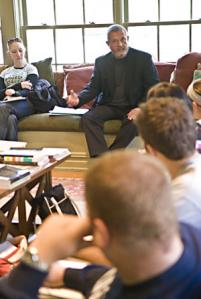
When Writers Write Together

by Susan Lawson


As writers write together in my house
clouds gather outside
and close the door on the sun
so our shadows can play
unseen.

After the writers leave my house
rain pelts
     down in
          torrents and
gives the grass back its breath
gives the flowers back their sighing
gives the sky over to its
long       sought-after      release
then washes the road
each writer
travels home.


These words came to me this morning as I looked out the window over my desk onto another gray and rainy day. But instead of it depressing me, I thought about how fresh and green everything looked now that we'd experienced a few consecutive days of rain after more than a week of hot and dry days. 

The lady's mantle I planted in the spring displays a shimmer of droplets in its cape-like leaves. A spider web that spans the space between a large rock and a cat statue, beneath which one of my kitties is buried, now supports a blanket of glistening raindrops. The cup of a geode half collects water like a miniature birdbath, and a male goldfinch drinks from it.

This time the dry spell broke on Saturday morning, shortly after my writing group broke up around noon. My writers had just enough time to make it to their cars and start home before the rain let loose in a riotous downpour. A couple sent me emails later, noting that the storm went with them, whether they traveled north or south.

I have regular writers in this group who come most every week. I have others who pop in and out about once a month or so. And then there are all the other writers--you perhaps--who I've encountered in the years I've taught who never come to a group at all, now that they aren't made free by the library. I worry about them. I wonder what keeps them going. I think that's where this poem comes from.

Something happens when we gather together and write. Whatever this something is, it gets better the longer we do it and the more we get to know the other writers in our group and their voices. We learn from each other. Not only techniques to try in our own poems or stories or essays, but how to live braver and truer, how to not be so hard on ourselves, how to see beauty wherever we find ourselves, how to listen and bear witness, and perhaps most importantly, how to play and have fun.

I write more on my own when I write regularly in a group. I also write better. I find more stories to tell. I hear more poetry in my everyday life. I can't put a price on this, though in my group I charge a fee for others to attend and spend this time with me. 

Believe me, what I charge doesn't even begin to offset my addictions to office supplies and books! But it does convey the message that to live the writing life will cost us something. There will be other things and people we must learn to say no to if we are to say yes to our writing. Mostly it's difficult to say yes with how we spend our time. Sometimes investing our money in the direction we want our time to go moves us down the right road.

If you'd like to write in a group, details about my Saturday group can be found here and here. If Saturday mornings don't work for you, let me know what would in the comments section (your personal information will not appear). If I can get enough people interested in meeting another day, I'll start a second group! Or, consider individual coaching; it's a little pricier but more in-depth. Details for that are here.

And if none of these suggestions are options for you right now, paper, pens and pencils comes in all price ranges, and the library carries lots of books on writing. Listed below are some of my favorites. So stock up, and don't forget your umbrella!


23 June 2013

Lessons of the Garden

"Cease looking for flowers. 
There blooms a garden in your own home." 
- Rumi
The prompt at my Saturday morning group June 22 was a poem called "The Lesson of Texas" by Cheryl Parsons Darnell, anthologized in a book called Wounded Healers (Rachel Naomi Remen, editor, Wounded Healers Press, 1994).*

We had just talked about various kinds of imagery--simile, metaphor, extended metaphor, personification and allusion. I used the poem as an example of extended metaphor, and we talked about its multiple layers of meaning.

I asked my group of writers to pen their own poem, story or essay on "The Lesson of ____," filling in the blank with whatever they chose and writing something that had more than one layer of meaning. I also asked them to use repetition of at least one phrase or sentence throughout their piece. Darnell repeats "do not surprise you" and "I grew up in Texas."

Here is what I wrote:


The Lesson of the Garden
by Susan Lawson

A girl’s got to be half-
way through her life
to call herself a gardener
and mean it.

She’s got to be halfway
through her life
to give herself the go-ahead
to dig in the earth and know
her own dirt for its true nature—
sand’s grit or clay’s muck,
so much rock up top
the plants cook
or so much rock below
the roots give up because
they can’t push through.

A girl’s got to be halfway through
her life before she learns
how to turn what she’s stuck with
into the fluffy crumbs called loam.
She’s got to be ready to make
a lot of mistakes before
anything
worthwhile
comes together
because that’s how gardeners learn.
She’s got to resign herself to watching
innocents planted in the wrong place die
while interlopers over-run
an unsuspecting lawn.

A girl’s got to be halfway through her life
to recognize a good tool when she sees it—
the spade with the hardwood back
and relentless bite, the deep-brimmed hat that
shades her face, the clippers that make
short work of the thickest brush. She’s
got to be halfway through her life to respect
the contributions of all creatures—
worms for their composting,
ants for their fearlessness,
birds for their willingness to sing
while spreading seed—because,
let’s face it, she's going to hose off
a lot of bird and bug shit in her time.

So much so
she needs to
keep her eyes on
the prize of
cool water
on bare toes
at a hot day’s
end and
the righteous
slap of
wet soles
on concrete.

I said
to call herself a gardener
she’d have to mean it.

A girl’s got to be halfway through her life
before she learns
not to get in the way of
what nature sets in motion
for reasons all its own—
the raccoon who empties a duck nest
of its eggs, the drake who seems
to stalk and rape his mate,
the bony mallard wing cast off
by a hawk who’s had his fill.
She’s got to be halfway through her life
before she sees past ugliness
all the way to beauty.

I’ve heard people say that
life began in a garden and then
like some kind of calamity came along
in the shape of a girl and spoiled
it all. But I am a girl half-
way through my life and I say
Look around and I mean it:
We make a garden 
wherever we be.

* Thanks to Amy Lyles Wilson for sharing this prompt with me.


16 June 2013

All Open All

Sometimes the simplest writing prompts are the best. And sometimes--probably quite often--prompts are all around us in nature.

At my Saturday morning writing group June 15, we met on my patio, and I plucked a prompt from my tropical hibiscus patio tree.

We passed the seven-inch diameter, deep coral bloom from hand to hand, and each of us--all women this week--took a turn at tucking it over one of our ears, like we were posing for Gauguin to paint our portrait.

This particular bloom lasts only one day; tomorrow a different bud will open and this one will shrivel up.

When the bloom reached me, I turned it over and discovered a sort of gaily striped beach umbrella as the coral seemed spun out from a lemony cream. There is no fragrance, but the lush bloom is openly sexual-looking, inviting; not surprising since all flowers are reproductive organs and their beauty is meant to attract pollinators. Butterflies and hummingbirds tend toward the red end of the color spectrum, while bees prefer blues.

But attraction has its place in creative endeavors, as well as procreative ones, and that's what the bloom makes me think of every time I look at it. It's why I buy one most summers! Here's what I wrote...


All Open All

I want to be all open like
a tropical hibiscus bloom

spread wide to take in each day
like it was my only one.

I want to live inside the color coral
like flame burning but not consuming

an invitation but not a trap.
A flower is all sex--

all legs spread wide
all orgasm all setting seed.

I want to be a sower.
I want to be sown.

I want to watch the harvest
from inside the root.

I want to send up bloom
after bloom after bloom--

each day every day a gift
that opens a dying world.


I think it's important to mention a little horticulture (and put my master gardening training to use): To pick a flower does not destroy the plant or cut short a bloom's life. In the case of hibiscus, you can actually prolong the flower's beauty for several days if you float it in a bowl of water. (And it makes a gorgeous centerpiece too!)

You see, a plant is all about producing seed to ensure its future, and seed is the fruit of a pollinated flower, which only ripens as the bloom dies. Left on the plant, flowers may turn to seed quite rapidly and stop blooming. So picking off withered blooms isn't just about aesthetics; it actually encourages the plant to produce more flowers.

We unintentionally cut short the plant's beauty-giving ability by not picking, in the same way we miss out on something very special in our human lives by not giving, by not risking, by not being open.

Here's wishing all of you the courage to be all open all.

12 June 2013

Thanks again, Bev

Thanks to Beverly Crawford for allowing me to use her beautiful artwork in my website nameplate AGAIN. Bev was a familiar face at my library writing workshops--one of the west-side gang who often popped up on other sides of town as well.

A great thing about Bev is that her writing is just as fun as her art, and she's generous with both. Check out her full art portfolio at http://indybev.blogspot.com. You'll find a sample of her writing on my YOUR WORDS page.

I change the art in my blog header every few months as the spirits move me. So if you'd like me to consider something you've done, please email me.

09 April 2013

Face to face with a fox

I wrote about my face-to-face encounter with a fox in my suburban back yard for the first time several years back in a writers' group that met in my home.

It was just a few days after I heard one of my favorite poets, Mary Oliver, speak at Clowes Hall through the Butler University Visiting Writers Series. Oliver often writes about nature, and hearing her inspired me to try to write about my fox.

Since then, I've written about this encounter on several different occasions, always trying to "get it right" and figure out what he meant for me, in much the same way the poet Lucille Clifton did in her poems about fox sightings. Her fox was female; I felt sure mine was male. Don't ask me why, but at the time I felt as if he came for me, to show me something, though I didn't know what. He was beautiful enough to write about in and of himself without making him into a metaphor, but I never gave up on the idea to do so.

I hadn't thought about that fox in a while but woke up today with the thought that he meant grief. I laid in bed awake for a half-hour while this new version spun itself inside my head before I decided to get up earlier than I'd wanted to and write it down. The poem seemed to want little punctuation, so I tried to construct it in the manner of W. S. Merwin, whose perfected lines make punctuation superfluous in showing the reader how the poem should be read.

Anyway, here's what I came up with...

The Fox

...who bounds toward me so silently
across the intersections of
sleepy suburban backyards that

the down on the back of my neck pricks up and
whispy arm hairs snap to rigid attention as if to shout
turn your head and I do.

...who skids to a halt where grass meets gravel garden path
where my body waits in shoshin and locks eyes
with something dark and wild and other.

...is so like grief--

smaller than I thought he would be and
patient as he seems to cede me the shortcut 
with his careful circle of the garden perimeter

then stops across the street
and waits
and watches while

this fresh prey who
doesn’t know she’s caught in his
makeshift snare

presses hands over heart
as if to capture the gift of
its pounding.

My experience this morning also called to mind a poem by Ted Hughes entitled The Thought-Fox, assigned reading in a long-ago graduate class. The professor contended that Hughes' "thought-fox" was just as real as a flesh-and-blood fox, and that in writing about it Hughes gave it a distinct life. That's what I wanted to do with my fox. Hughes got the idea for his poem from a dream. (Listen to him discuss the dream and read his poem here.)

I think I've come close this time to conveying what my fox meant, though I have a ways to go before I can give Hughes, Merwin, Clifton or Oliver a run for their poetic money.

Jot down a few of your own "up close and personal" encounters with nature and/or wildlife. Go ahead and write about them, whether or not you think you already know their "inside" meanings. But pull the experience out of your writer's bag of tricks again and again and see if time gifts you with new insight.

18 March 2013

Enter the world of the surreal


Photographer Diane Arbus focused on traditionally marginal or disenfranchised populations--circus performers, nudists, the transgendered, the mentally retarded, dwarfs, giants--people whose everyday normality might be regarded by some as ugly or surreal. 

A print of Diane Arbus' Tattooed Man at a 
Carnival, Maryland 1970, sold for $50,400.
She always shot in black and white and generally composed her photos square in shape. She believed the camera could be "a little bit harsh, a little bit cold," but its scrutiny revealed facts: the difference between what people want others to see and what they really see. 

Consequently, her photos make excellent prompts for writing exercises. Techniques I've suggested in other blog posts about photos work here as well: Begin with what's in the photo itself, then write toward what's "beyond the frame." Plug her name into any search engine and come up with enough surreal photo prompts to keep you going for the rest of the year, or buy one of the books listed at the end of this post.

Writers at my March 9 group selected an Arbus photo to write about from a display on my kitchen table. The photo I chose is pictured here, and the poem I wrote that day appears below.

The resulting poem, story or essay should still "work" for the reader without the photo that inspired it. Does my poem pass that test? Here is a link to another poem I wrote based on two Arbus photos.


Tattooed Man

I carry with me this man
written on, drawn on
by all the world, whose
balding head sports
the smoking skull of shame
(you carry him too).

Eagles and bats, fists and stars,
tridents and roses, nets and thistles—
he gives his whole body over to
the needle and ink of
rapprochement.

So many colors of pens, so
many designs signed by those
who haven’t understood us.
Sometimes this those is
ourselves.

His eyes lock onto the road ahead
and never blink. He takes on what
others throw and makes
a master work only he can see—
always changing,
always changed.