12 January 2012

In the Never-Never Land of My Unfinished Novel


PROMPT: From my Nov. 6, 2011, workshop at Nora Branch of IMCPL. First we read the poem “The Mother” by Gwendolyn Brooks and talked about the idea of negative capability in writing (see a related handout under the "Resources" tab), Then I asked attendees to write about something that had presence and meaning in their lives because of its lack. Here’s what I wrote…

A psychic I met in grad school said she saw me with three children AND I would write three books. It took me most of the years between then and now to realize the two were the same thing: books are a writer’s children. She saw me that way, and I’ve been saying I wanted to be a novelist since the fourth grade, and yet to date, I’ve written no books, though I have managed to raise one human daughter.

I have written a great deal of nonfiction and a lot of this and that, including disparate parts of two novels. I have a vague idea for a third. My problem is I can’t seem to sustain the work—to string together the many pieces and fill in the blanks between them.  I’m not getting any younger, either. Last birthday I logged 55 years this incarnation.

Sometimes it’s life that gets in the way: helping my husband, my daughter, my dying mother, my elderly father, my difficult mother-in-law, my sick cat. Sometimes it’s internet shopping and computer games. I always have an excuse.

Each of my two novels in progress has its own mini-library of books on geographic or time settings. One novel takes place in present time in an invented town in the Finger Lakes Region of New York, while the other is set in Ancient Rome circa the reign of Caesar Augustus. The wall of my studio holds a large, framed image of my muse. It’s the reproduction of a fresco from a home in ancient Pompeii entitled “The Poetess.” The artist painted her head and shoulders in a rondelle, and she holds a book of wax tablets and a stylus, ready to make her mark on them.

Some people say she is Sappho, the famous Greek poetess from the Isle of Lesbos, but there’s no evidence of this. For one, this young woman is dressed as a well-to-do Roman. For another, she is too young to fit our idea of the middle-aged Sappho. My young woman is not far out of girlhood—perhaps 15 or 16. Her pose is a typical one used by itinerant artists and chosen by families wishing to immortalize someone, often someone who has recently died.

So into the vacuum of identity surrounding this I've projected an identity and made her the central character in my novel set in ancient Rome. I see her as someone who actually lived and whose family we know a great deal about, though we know little about her specifically. I see her as Sulpicia, the daughter of the orator Sulpicius, granddaughter of the jurist Sulpicius and niece to the general and statesman Marcus Valerius Corvinus Messalla, her mother’s brother and a contemporary of Caesar Augustus. 

Sulpicia is important because her few poems are the only poems written in Latin by a woman to have survived the centuries. We know from historical sources that educated Roman women did indeed write, and fragments of writings by women in other genres do exist. Her poems survived only because someone tucked them into the final volume of poems by Tibullus, published after his death. Tibullus, one of the Latin elegists, was a friend of Sulpicia’s uncle, Messalla, a patron of the arts. Sulpicia, Tibullus and Sulpicia’s younger brother are thought by historians to have been part of the circle of writers Messalla helped support.

It's thought she wrote her poems around age 15 to 19. But all we know for sure is what’s in them: She had a great and forbidden love with someone not of her social station. After that, she simply disappears. Scholars postulate she either married and wrote no more or died. My novel is about what happened to her—in my imagination, of course. I identified with her for all time when I read these bold and insistent lines, addressed to her lover:

     This day has brought a love
     it would shame me to conceal—
     won by song and prayer
     Venus gives him to my arms
     and all that she promised comes true.
     Let my love be told by the loveless,
     my letters go unsealed
     and any read them who will.
     If I sin, I glory in sinning:
     I will not wear virtue’s mask—
     the world shall know we have met
     and are worthy, one of the other.

She lived. She loved. She wrote about it. She disappeared. 

Will I do the same?

I have imagined often what it will be like to finish my days on earth and not finish my stories—never to complete what I set out to do, what I told everyone I wanted. Will someone like me, centuries from now, discover my bits and piece and imagine what connected them? What’s missing? Will she wonder what I wonder of Sulpicia? What happened to her? Where did she go? Will I speak to this future writer from my grave of paper wads and empty ink cartridges, as I believe Sulpicia speaks to me from her grave of wax tablets and papyrus?

Someone in a writing group I attended once asked when I finished reading an excerpt, “How is it that someone with your talent hasn’t already written many, many books?”

The honor she paid me touched me deeply, and my eyes clouded with tears because of how it filled me up and emptied me out all at once. The answer I gave her works for all the questions in this essay: “I don’t know,” I whispered and bowed my head. I felt shame.

I still don’t know. I feel like a failure most of the time, but I keep writing something. 

A Postscript

Part of what sets apart my writing workshops is that I take the same risks I ask participants to take: I write along with them and read aloud what I wrote at least once in each session. When I finished reading this piece, again there was a hush. I let the silence ride. Eventually a woman spoke. "I thought I was the only one who felt that way," she said. Others voiced and nodded agreement.

It helps to know we're not alone on this journey. Sulpicia had the Messalla Circle. I'm glad to have all of you. Love is not the only thing it shames us to conceal.

Please enjoy this recording of Gwendolyn Brooks reading "The Mother."


07 January 2012

Two Peas in a (Writing) Pod

Listen to an interview with humorists Dave Barry and Alan Zweibel, or read the transcript, as they discuss their collaboration on the just-released novel Lunatics. The story is told by two very different characters in alternating chapters.

Here's how it worked: Barry would write his chapter from his character's perpsective, then send it to Zweibel, who wrote in the other character's voice. Whenever the latest chapter arrived in their email inbox, they really never knew what to expect and had to move the story along with whatever the other person had given them.

You can try this for fun, and who knows? You may end up with something you want to shop around to publishers. This pair suggests you choose someone you get along well with but whose writer's voice is the opposite of yours. This opposition is what will give the story its energy and keep readers interested.

They also said they only met about twice during the whole process, that all the "work" was really done by email. So if you have a writing pal who doesn't live close, this is a fun way to keep in touch!


06 January 2012

Between the Lines

PROMPT: Choose a poem you think will work well as a prompt. At the E. 38th St. IMCPL branch in late October 2011, we started with "Fire" by Joy Harjo from her book What Moon Drove Me to This? Cross out every other line (it doesn't matter whether you start with the first or second line) and write lines of your own to fit with the remaining original lines. Then, cross out the remaining lines of the original poem and write more lines of your own to go with those you already wrote so that what you end up with is a poem that's wholly yours. 


Here's what I wrote...

Between the Lines

No one hears
a voice unspoken.
Each person must walk into
the timbre of her own breath.
Every One must dance into
the beauty of her own resonance--
flirting, flitting from word to word to word
like lovers wrestling in the damp night.
A body must journey into its deepest throat
no matter what the cost. See--
the cancer cut from inside my neck
was not the end but a new start. My voice
goes on and on even as I sleep
like water rippling in moonlight.
My dreams, my pen become a tongue
for those weary of talk. I am become
a breeze that bristles dry autumn leaves
to ground. I mulch the earth's madness
with whatever laughter or tears
I launch into the darkness.


23 November 2010

Of Sugar and Snow

PROMPT: Write about your associations with a particular food. Here's what I came up with...

Ice cream scoops and churns its cold, creamy sweetness through memories of my family as we grew up together.

“I want to ride with Uncle Jack,” my cousin Beth said on a trip our families took together to Cooperstown and the Baseball Hall of Fame, “because whenever you stop at an ice cream stand along the way, Uncle Jack buys you the big cone.” Beth’s mother was only a year behind her brother, my dad, in school, but when it came to ice cream they were an ice age apart.

We had an ice cream snack from a grocery store carton nearly every night growing up. And then wasn’t like now with all the gourmet brands and exotic flavors. Mostly it was vanilla, chocolate or fudge ripple. And it tasted of the freezer’s dull breath before we ate the carton empty, but that never kept us from scraping out every last layer and smear.

I remember...

I remember rides in the country to find farmers’ dairies where they made their own, and dad chattering about how he cranked it for my mom’s dad when they made it down on the farm in Dayton, Pennsylvania. They had to eat the whole freezer-full up in one sitting because the only refrigeration was a spring house. Some problem to have, huh?

I remember how dad always had change for Klondikes all around when we stopped in Joe Roebel’s store for a pound of chipped ham and a loaf of bread and how he was the only dad on the block who’d spot all the kids for a drumstick or a fudge bar or a Bomb when the ice cream truck ambled past our house in Rolling Hills, near Irwin, Pennsylvania.

I remember trips to the shopping center in Pittsford, New York, where dad bought each of us one of those slabs of Neapolitan ice cream stuffed between two waffley cream crackers, like a sandwich. I remember trips in my jammies to the Elmira, New York, Dairy Queen and my first chocolate sundae with Spanish peanuts I wanted because they sounded exotic but loved for the combination of salt and crunch mixed up with the sweet and cold. 

Jewels, jobs and journeys

When my parents decided to invest in a piece of family jewelry, they chose a brooch shaped like a crown. I was the one who came up with the idea for arranging the birthstones: two each for mom, dad, each of my two brothers and myself, which translated to four rubies, four amethysts and two pale blue topaz. Whenever mom wore that crown pinned on her shoulder I thought “Dairy Queen” and my mouth would water and long for creamy coolness.

Not surprising, then, that my first job was at a Dairy Queen in Southport, Indiana. I remember practicing my curls at the ice cream machine when we weren’t busy and cutting the undulations of soft-serve off at the cone lip into a bucket the owner would recycle into more soft-serve. I learned how to make ice cream into Dilly Bars and Buster Bars, Blizzards and sundaes and Brownie Delights.

I also remember going to the Dairy Queen with a neighbor whose daughter was my best friend. He let us order not just the biggest cone, but anything we wanted. I had my first banana split in the back seat of his Thunderbird, with the top down on a hot summer night, and I couldn’t finish it. He was a doctor, a cardiologist, and it was banana splits all around—for me, his daughter Gail, her brother Steven, and his friend Pete. Except for Doc. He got a Dilly Bar. Every time he ever took us, Doc got a Dilly Bar, along with a bag of Dilly Bars in a take-home sack. I thought about this years later, every time I made the Dilly Bars at my part-time job.

When I began to question some of my childhood experiences that were more about cold than sweet, I dreamed I was trapped against a deserted Dairy Queen stand at the edge of a park. I climbed up onto the service counter and huddled against the shut and locked window. A vicious dog barked and snapped at my feet.

I don’t eat ice cream so much anymore—too fattening, too habit-forming, too charged with comfort and with sorrow. But when I do, I sculpt away the melting edges like an artist working in soft clay, and I let the spoon linger in my mouth until all the creaminess has given up the metal and sunk into my tongue. I never stopped loving it.

Ice cream and end times

In the last couple weeks my mom was alive, I tried to entice her to eat by bringing her whatever she wanted. Included in the food order was always a vanilla Frosty from Wendy's. Eventually, she left the solid food untouched, and the Frosty was the only thing that tempted her. When she could no longer feed herself, I spooned the Frosty into her mouth. She had trouble talking, but she managed to get me to understand she wanted bigger spoonfuls. The last couple days, she wasn't allowed anything for fear she'd aspirate it. She seemed hungry, thirsty. It was difficult to see her that way and not be able to do anything about it.

These days, since mom's passing, I sometimes eat lunch or dinner with my dad in the dining room at the assisted living place where he still has an apartment. He always asks for and they always bring him a scoop of ice cream for dessert; usually he asks for butter pecan. And I watch back through the years as the bowl empties, when it empties. Sometimes now he only takes a few bites and leaves the rest to turn to mush, a thing he'd never have done years before. His look is far away. We both miss mom. 

My life has been filled with so much coldness and so much sweetness. What to make of both? Like chocolate and vanilla, each sharpens my taste of the other. Maybe the only answer left is to share dad's scoop with him. We'll do it for mom, who always hated to see anything go to waste. Wish she could join us for one last bite.

08 November 2010

Self-Portrait

PROMPT: Photos by Diane Arbus. Click on the link to view some. Here's the poem I wrote...


After two photographs by Diane Arbus:
"Self-Portrait, Pregnant, NYC, 1945" and
"Albino Sword Swallower at a Carnival"

When I sit down to write I am
the photographer who has stepped from
behind her camera and
undressed. This is why each time the film
moves forward and the shutter clicks
it is called exposure.

We see in the mirror
on the back of a bedroom door
the bed draped in mid-century chenille
which flows away like the sea and
escapes the blank apartment walls.
She is pregnant with her first child.
She took the photo
to send to her absent husband.
The child will be a girl.

When she snapped the one of
the carnival woman swallowing the sword
was she making a plea for
an unimpeded voice or
watching her own death:
the straight path from heart to mouth
with no sudden woundings?

The woman without color spreads her arms wide
as if in ecstatic praise, as if in bloom.
A weathered tent billows darkly against her back.
Wind tugs at the guy wires. Her tiered
& scalloped skirt sways left as she leans right.
See me, her body seems to say, from a chest so full.
See me   --  Click!
See me open.


PS: Follow the link to find out more about photographer Diane Arbus on Artsy.

31 August 2010

Letting My 'Inner Mowgli' Out For Some Fresh Air

If I could create an ideal world for myself, like I was asked to in a writing group recently, I would be the female equivalent of Mowgli, Rudyard Kipling’s much-loved jungle boy, raised by wolves, friend of most, if not all, animals in The Jungle Book.  I sometimes wish I had been raised by panthers, bears, wolves—my very own Bagheera, Baloo and Akela.

In this world, I'm often tortured by my inability to say the "right" thing and my propensity to blurt out the wrong one. Some acquaintances, reading this post, may say to themselves, Ah yes! That explains it!  But maybe I'm a misfit in this world because there's another one I really belonged to once. Indeed, the places in my childhood where nature and I touched constitute my most clear and vivid memories. My earliest memory, at age 3, is peering into a robin’s nest at a freshly laid, vibrantly turquoise egg. Now, turquoise is the color of my studio walls.

I also remember a thicket...

It separated our yard from a neighbor’s. My mother (yes, I had one, an actual human) called it a gully and tried in vain to keep me out. When she wasn’t looking I wriggled up and down a scrubby apple tree whose fruit was so green and sour it gave me a bellyache every time I ate it, which I did often, on principle. Or, in the deeper part of the thicket, I followed narrow trails mother nature left for me, round and around, in a spiral. I sat cross-legged on the dirt at the center, smashed berries mom said were poisonous into a pretend stew with a stick. I told myself stories. I imagined myself as characters I invented. I became a writer.

Much of this took place in upstate New York, in the Finger Lakes region—lands the Iroquois settled before the Europeans, a far cry from New York City downstate. Seneca, Keuka, Canandaigua, Cayuga were the lakes close by, but I also remember Chatauqua and Otsego, and hearing and seeing Iroquois names everywhere. The lakes spread across the state's middle like slender, outstretched fingers on a pair of open hands. The water was clear, and rounded pebbles carpeted lake floors. I remember steep and rocky cliffs, gorges and waterfalls. Along one cascading stream I found a geode, its homely exterior belying a blaze inside: quartz crystal shards in shades of white and orange. I carried it with me to every place we lived after until we landed in flat, seemingly indistinct Indiana. The Finger Lakes were, to me, like what the Iroquois thought: God’s hands, in this case, rested upon my young life.

Back home again in…where?

Ultimately, it was the geology of New York state I missed more than friends or schools or neighbors when we moved. I often imagine how I might have grown up differently—better—if we'd stayed there. Odd that we ended up in a place named for Native Americans, in Indiana, a place I haven't always appreciated. But Indiana is where I found the man I'll always love. It's the place I came eye-to-eye with a fox in my garden—something he AND I will never forget! It's a place where I've watched saplings grow into shade trees in a yard of my own. And everyday I go on living here, Indiana surprises me. 

A few weeks ago, following one of the covered bridge trails in Parke County, something I saw took my breath away. Our car turned a bend and surprised a white-tailed deer—a doe—eating in a field of tall corn. Only her head was visible, dipping up and down, nibbling on the stalks' tender ears. As we slowed and steered to the shoulder, we saw two smaller heads—noses and ears to be exact. The threesome reminded me of musical notes, their bobbing heads a melody dancing across a page. A page of Indiana: What could be more "right" than a rolling field of corn?

The doe’s velvet ears stiffened at our presence, and before we came to a stop, before I could get my camera out—before I could say, Hey! Wait for me!—she bounded across the road and into a woods. She stood stock still and back far enough so that the forest hid all but her legs. She'd succeeded in calling our attention away from her babies. First one fawn emerged from the corn and crossed clumsily into the darkness, and then another, both still in their spots. My only photo is a blur of the last spotted brown rump being swallowed by the dim, silent forest.

What is silence anyway, and what good is it?

How hard it is in the world we inhabit to find a truly silent place! For even when you’re able to turn down the volume of civilization, something is always making itself heard. For me, silence steps forward when road noise fades—no singing tires, no squealing brakes, no revving engines. When I get there—if I get there—I inventory the multitude of other sounds that heretofore were hidden by everyday life. I hear water sloshing, birdsong, gurgles in the woods I surmise are made by a wild turkey, but I really can’t say because I see nothing in the stillness. If I lived in such a place—had been reared there—I would know the name of every one of those sounds—at least its “forest" name, and knowing would make it truer somehow. Or so I imagine.

How would it change the world, for instance, if we could hear the the prayer of the mouse as the hawk swallows it down? Or the missive of the fish, as it's scooped up by a bear? If only we could give ourselves over to that way of thinking about life, about death! If only I could...

At the least, I want nature to help me understand the hurts I see people inflict on one another, the hurts others do to me, the hurts I cause. But, all in all, spending time in the quiet of a deeper wilderness than my day-to-day one makes me care less about the world of people. How much better a use of my attention to watch a heron make the rounds of coves at Raccoon Lake, wade out into the shallows on straw-like legs, fish for his supper with his beak in the late afternoon breezes, after the skiers and their boats have gone home. Or to count the birds of prey (hawks? eagles? turkey vultures?) overhead—12, no 15!—buoyed on air currents exhaled by the interplay of water and sun. 

My favorite experience of nature, if I must choose just one, is wind. By itself it has no sound and can’t be seen. It depends on impedance—branches swayed, leaves rattled, water lapped against another resistance, the shore—to make its music and its paintings. Resistance is what gives the wind its character. And I know then I’ve come full circle. Resistance—impedance—also defines character in my messy, imperfect day-to-day life. Not only standing against something, but standing with it, bending, being bowled over or merely rattled or untouched.

I doubt I could last a night in a true wilderness, but I can glimpse one sometimes and let it fill me up. We all have an inner Mowgli, and we all need to let it out to breathe in. To breathe in silence and song and an idea of who we were before we "grew up." I'm told (but don't quote me on this) it helps the disposition. Leastways, it does wonders for mine.


24 July 2010

Living Beyond the Landscape: A Parable

PROMPT: Write the story behind and/or associations with a treasured object of yours. Here's what I got...

The woman bought the fan on their first date--an exhibit of art for sale by Li Xing-Bai, a visiting scholar at a nearby university, one of the Communist Republic of China's earliest gifts of cultural exchange with the United States in the 1980s. A mutual friend and coworker of the couple arranged the exhibit in a town hall of a tiny German settlement tucked within a diverse metropolis in the Midwest. Mr. Li was a good friend of the coworker, who was also an artist.

Could she even call this a date? The man had left his wife for her. They made plans both to attend the exhibit so they could spend time together in public before his divorce was final without arousing suspicion. The woman brought along her best girlfriend as additional cover, but also because she wanted her to meet the man. But the hierarchy of friendship was in flux. When the woman was out of earshot, the friend grilled the man about his intentions, for she felt the balance of relationship changing.

While the drama between the man and the friend unfolded, the woman gazed absently at the art and intently at the prices. Even the fan she chose was more than she could afford at the time. As she paid, the coworker introduced her to Mr. Li, who spoke to her in Chinese, which the coworker translated.

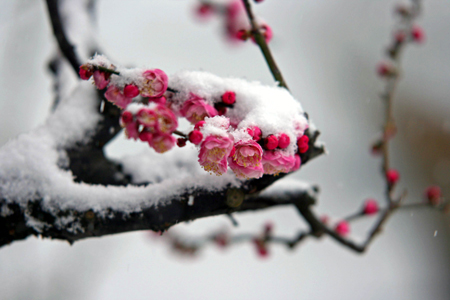
"He says you have chosen wisest among all here, for there is first the fan itself, which he made from 300-year-old rice paper, then there is the painting on one side, and finally, there is a poem, in calligraphy, on the other." The coworker turned the fan over to reveal elegant Han characters in swirling black paint and the personal stamps of the artist in red. Mr. Li continued in Chinese as the coworker first listened, then translated. "A loose rendering of the poem is, he says, The plum blossom is the bravest among flowers because it blooms first, sometimes before the snows end, and so it stands alone against the cold."

The coworker turned the fan back over to the landscape side, and the woman looked anew at the branches dotted with purple buds, some blossoms blood-red and others blush-white, only the suggestion of snow. Mr. Li and she exchanged smiles, and he bowed to her as the coworker collapsed the fan and placed it in a protective bag.

The friend passed out of the woman's life even before the wedding took place. The coworker came to the wedding but retired from the workplace the three shared, sick and bitter in his heart. And Mr. Li, when his visa expired, escaped north, at least for a while, with a Canadian graduate student who studied under him in his years at the nearby university, thus leaving his Chinese wife and children to tend his landscapes in Beijing.

The woman's purchase gathered dust and tears, first open on shelves and then folded away in cupboards, until, in the time of the couple's 20th year together, she mounted it on silk two shades darker than the rice paper had become and placed it in a display box.

It hangs now in their living room, where she and the man who ran away to her all those years before see it daily from a room away as they wait for their coffee to brew. Visitors to the home they made together see the landscape side, but the poem on the reverse remains their secret.